
Olink® Proteomics

What is Olink®?
Olink® proteomics technology enables highly multiplexed protein biomarker analysis using Proximity Extension Assay (PEA) technology, a dual-recognition immunoassay approach designed for exceptional specificity and sensitivity (Figure 1 below). By combining antibody-based detection with next-generation sequencing (NGS) or qPCR readouts, Olink platforms support the simultaneous measurement of hundreds to thousands of proteins from minimal sample input.
At the Immune Monitoring and Cancer Omics Labs, we leverage Olink proteomics workflows as a Certified Service Provider to support translational research, immune profiling, cytokine analysis, oncology biomarker discovery, neurodegeneration studies, and systems biology applications across academic, biotech, and clinical research programs.
Olink assays are optimized for plasma, serum, and many other biologically relevant sample matrices, enabling high-dimensional protein analysis from as little as 1–4 µL of sample input depending on platform selection.
Why Olink®?
Exceptional Specificity
Olink PEA technology uses paired antibody probes and DNA barcoding strategies to minimize cross-reactivity and improve analytical specificity.
Minimal Sample Requirements
Analyze thousands of protein biomarkers using as little as 1 µL for Target 48, Target 96, and Flex, and 4µL for flex. Sample types include plasma, serum, CSF, and many others - schedule a consultation to learn more.
High-Plex Biomarker Discovery
Profile up to ~5,400 protein assays with Olink Explore HT for large-scale systems biology and translational proteomics studies.
Built-In Quality Control
Integrated controls and NPX normalization workflows support reproducible, high-confidence protein expression analysis.
Olink Proteomics services for Immune monitoring and Biomarker Discovery
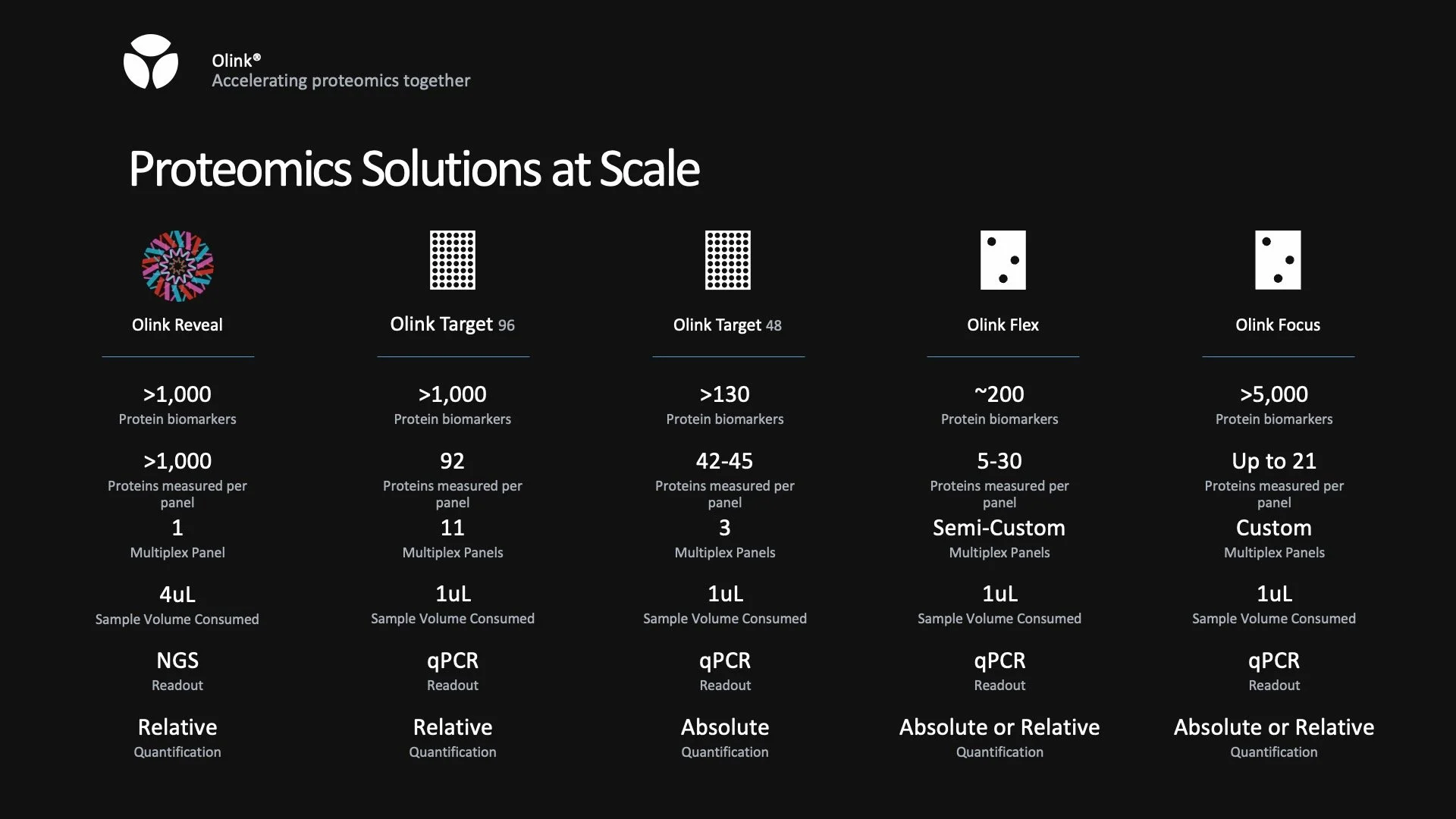
High-sensitivity multiplex proteomics using Olink® Reveal and Olink® Target platforms for translational research, cytokine profiling, immune-oncology, neuroinflammation, and precision biomarker discovery.
21 different panels built from a library of 5400+ proteins
1µL of sample required
Data reported through our personalized data analytics pipeline
Raw output in absolute quantification (pg/mL) or relative units (NPX)

Figure 1. Protein measurement with Olink proximity extension assay (PEA) technology. (A) Samples are mixed with paired antibodies labeled with complementary DNA oligonucleotides. When the antibody pair correctly binds to its target protein in solution, the oligonucleotides hybridize to each other. (B) The hybridized oligonucleotides are amplified via PCR and analyzed with next-generation sequencing or qPCR. (C) No DNA amplicons are generated if nonspecific binding occurs.
Certified Olink® Service Provider
Immune Monitoring and Cancer Omics Labs is proud to support investigators as an experienced Olink® proteomics service provider for translational and biomarker discovery research. Our team provides end-to-end support for Olink Reveal, Target 48, Target 96, and Olink Flex workflows, including study design consultation, sample handling guidance, assay execution, quality control review, quantitative and NPX data reporting, and downstream bioinformatics analysis.
As a laboratory experienced in high-dimensional immune profiling and multiplex proteomics workflows, IMCO collaborates with academic, biotech, and clinical research teams to generate robust and biologically meaningful protein biomarker datasets.

Olink Target 48 & Target 96
18 different panels. Up to 88 samples, and up to 92 markers of interest per panel.

Olink Flex & Olink Focus
Personalized panel creation, 5-30 markers from a library selection of up to 5400 proteins across 40 samples.

Olink Reveal
Enables the measurement of up to 1,000 robustly detectable protein biomarkers, offering broad proteome coverage and deep insights into inflammation processes

Olink Proximity Extension Assay (PEA)
How it works:
Olink Data Analysis & Bioinformatics Support
Immune Monitoring and Cancer Omics Labs provides end-to-end support for Olink proteomics studies, including experimental design consultation, quality control review, normalization assessment, and downstream bioinformatics analysis.
Our analytical workflows support:
NPX data interpretation
differential protein expression analysis
longitudinal biomarker modeling
pathway enrichment analysis
immune signature profiling
multi-omics integration
machine learning applications
publication-ready visualization
We work collaboratively with investigators to transform high-dimensional proteomics data into biologically meaningful insights.
Longstanding Experience with Olink® Proteomics
Immune Monitoring and Cancer Omics Labs has extensive experience supporting translational proteomics and immune profiling studies using Olink® platforms and workflows. As an early adopter of Olink PEA technology, our team has supported investigators across biomarker discovery, cytokine profiling, immuno-oncology, neuroinflammation, infectious disease research, and longitudinal immune monitoring applications.
Our experience spans Olink® Reveal, Olink® Target 96, Olink® Target 48, and Olink® Flex workflows, including study design consultation, sample processing, assay execution, quality control review, NPX interpretation, quantitative reporting strategies, and downstream bioinformatics analysis. By combining deep immunology expertise with high-dimensional proteomics capabilities, IMCO helps researchers generate biologically meaningful insights from complex protein expression datasets.
Olink FAQs
-
Normalized Protein eXpression (NPX) is Olink’s relative quantification unit generated through internal and external normalization controls designed to reduce technical variation between runs.
-
Depending on the platform, Olink assays typically require approximately 1 µL to 4 µL plasma, serum, or other compatible sample matrices.
-
Proximity Extension Assay (PEA) technology uses matched antibody probe pairs linked to DNA oligonucleotides. When both antibodies bind the same protein target, the oligonucleotides hybridize and generate a measurable DNA barcode signal.
-
Olink Reveal supports large-scale discovery proteomics with ~10000 protein assays, while Olink Target 96 & 48 provides focused hypothesis-driven panels targeting 92 and 45 proteins associated with specific disease areas or biological pathways.
-
Olink® data are commonly reported as NPX (Normalized Protein eXpression) values, a relative quantification unit generated through standardized normalization workflows and internal assay controls. NPX values are log2-scaled and optimized for comparative statistical analysis across samples and study cohorts. Depending on study goals and assay selection, certain workflows may also support absolute concentration reporting in quantitative units such as pg/mL through calibrated assay approaches and downstream analytical interpretation.
Immune Monitoring and Cancer Omics Labs provides comprehensive downstream data analysis support for Olink proteomics studies, including QC assessment, normalization review, differential protein expression analysis, longitudinal biomarker modeling, pathway enrichment analysis, publication-ready visualizations, and integrative multi-omics interpretation. Our team works collaboratively with investigators to transform high-dimensional proteomics datasets into biologically meaningful and actionable insights.
-
Yes. Olink® proteomics data are frequently integrated with other high-dimensional datasets including RNA sequencing, single-cell sequencing, CyTOF, flow cytometry, spatial biology, genomics, and metabolomics workflows to support systems biology and multi-omics research strategies.
-
Olink® assays are designed to support broad dynamic range protein detection, enabling quantification of proteins across multiple orders of magnitude within a single workflow. This allows simultaneous analysis of both low-abundance and high-abundance protein biomarkers.
-
Traditional ELISA workflows generally measure one or a small number of proteins per assay, whereas Olink® multiplex proteomics enables simultaneous analysis of dozens to thousands of proteins using minimal sample volume. Olink PEA technology also incorporates dual-recognition antibody binding strategies designed to enhance analytical specificity.
-
Olink® platforms are widely used in translational research, biomarker discovery, population health studies, pharmaceutical development, and academic research applications. Researchers commonly leverage Olink workflows to investigate disease biology, therapeutic response, immune signaling, and longitudinal biomarker dynamics.